
I.
This exhibition, Urdu Worlds, stages a conversation between a body of works by the legendary printmaker, Zarina1 (b. Aligarh, 1937–d. London, 2020), and an expansive survey of two decades of work by Ali Kazim (b. Pattoki, 1979). The exhibition title is borrowed from a text I wrote on Zarina’s passing in 2020,2 and points to the capacity of artists to manifest their imaginative worlds through their work. This exhibition is an invitation for audiences to enter these worlds, and experience them at the level of feeling – without linguistic translation.
Zarina and Kazim come from different generations, and were born in neighbouring countries divided at birth (India and Pakistan). They lived continents apart (Zarina mostly in New York, Kazim in Lahore) and worked in distinctive ways; but their work shares a common commitment to the Urdu language. Both artists engage directly with Urdu literature: Zarina often incorporated Urdu poetry (Faiz Ahmad Faiz, Mirza Ghalib, Allama Iqbal…) and text in her prints, and Kazim’s work has been informed by the writings of Naiyer Masud, Gopi Chand Narang and Muneer Niazi among others. Both artists have also produced books that enable others to engage with Urdu.

For Zarina this took the form of Urdu kay aik so aik mahavray (101 Urdu Proverbs, 1991) – a slim hard-bound volume of a hundred and one proverbs in Urdu script selected by her sister, Kishwar Chishti (or Rani), and punctuated with ten exquisite woodcuts by Zarina which act as visual abstractions of the chosen proverbs. Sarah Burney, in her specially commissioned text for this exhibition (‘Zarina’s Urdu Worlds’), considers the book, the Urdu Proverbs (1991) print portfolio and its re-strike (2011) as a multi-stop artistic journey that indexes the increasingly central role Urdu played both in Zarina’s practice, and as an expression of her identity.
Zarina gifted the book liberally, particularly to those raising children in the diaspora. Both my boys have their inscribed copies. It was partly Zarina’s book that inspired Kazim and myself to collaborate on Ali Kazim: Alphabet Book | Urdu Qaida (Ochre Books, 2026), an introduction to the letters of the Urdu alphabet for English and Urdu readers alike, setting them alongside Kazim’s gaze into South Asia’s flora and fauna, as well at its histories and legends, and the everyday cosmopolitanism visible on its streets. Both these artist books serve as alternative ways to enter ‘Urdu worlds’.
II.
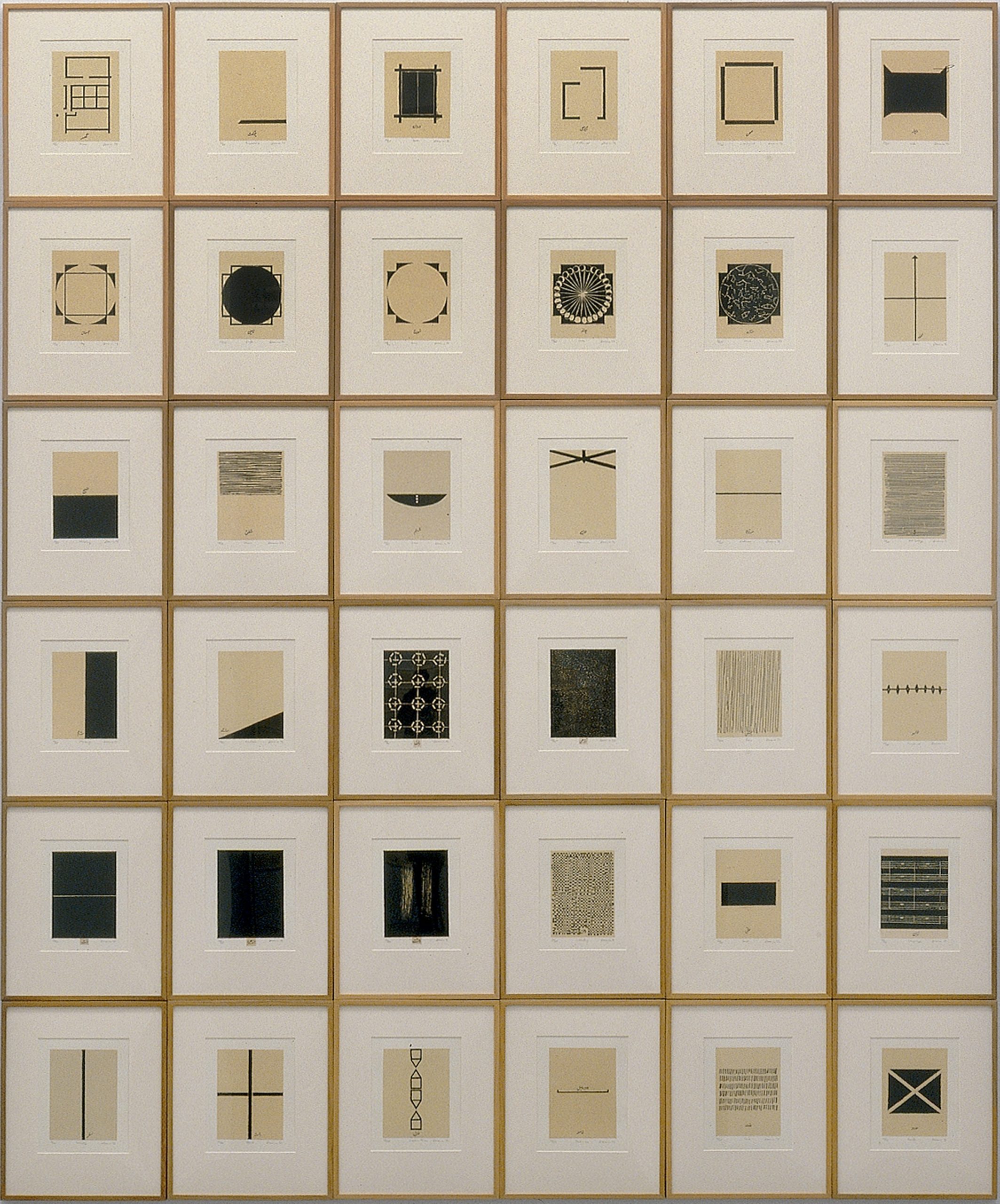
Zarina called herself an ‘Urdu artist’, finding herself ‘too Muslim for the US and India, and too Indian for Pakistan’.3 ‘Urdu is home’ she declared.4 Home is a Foreign Place (1999), a portfolio of 36 woodcuts, ‘is the most expansive articulation of her Urdu worldmaking’.5 Each print pairs abstract forms with single word titles in Urdu, forming a critical dictionary for home that operates in multiple registers: from the concrete (Door, Entrance, Wall…) to the celestial (Sky, Moon, Stars…); from cycles of time (Dawn, Afternoon, Evening…) to atmospheric phenomena (Rain, Dust, Hot Breeze…); from states of perception (Fragrance, Despair, Silence…) to the politics of belonging (Border, Language, Nation…). Each word carries a ‘cultural weight’ that allows those familiar with both the language and its associated etiquette of use (tehzib) to read not just multiple meanings but codes of behaviour. Zabaan is not just the word used for ‘language’, but also ‘tongue’, or to give one’s word, or one’s identity and honour. The word chaukhat (threshold) is not simply a physical structure, but articulates the act of ‘waiting for permission to enter a private space’.6
Zarina shared elements of this ‘private space’ liberally with her viewers through 50 years of print-making of remarkable subtlety, material restraint and poetic resonance. Her much-feted oeuvre is ‘populated by the homes she lived in, the places she visited, the skies she slept under, the fragrance of her mother’s garden, the warmth of North India’s rain, the languorous pall of a hot afternoon breeze, and familial letters of loss and longing.’7 These letters were often to, or by, her sister Rani, who eventually settled in post-Partition Pakistan, while Zarina made New York her physical home. The Urdu Proverbs book was a collaboration between the sisters, published by Zarina and printed, appropriately enough, in Karachi’s Urdu Bazar during one of Zarina’s frequent visits to her sister.
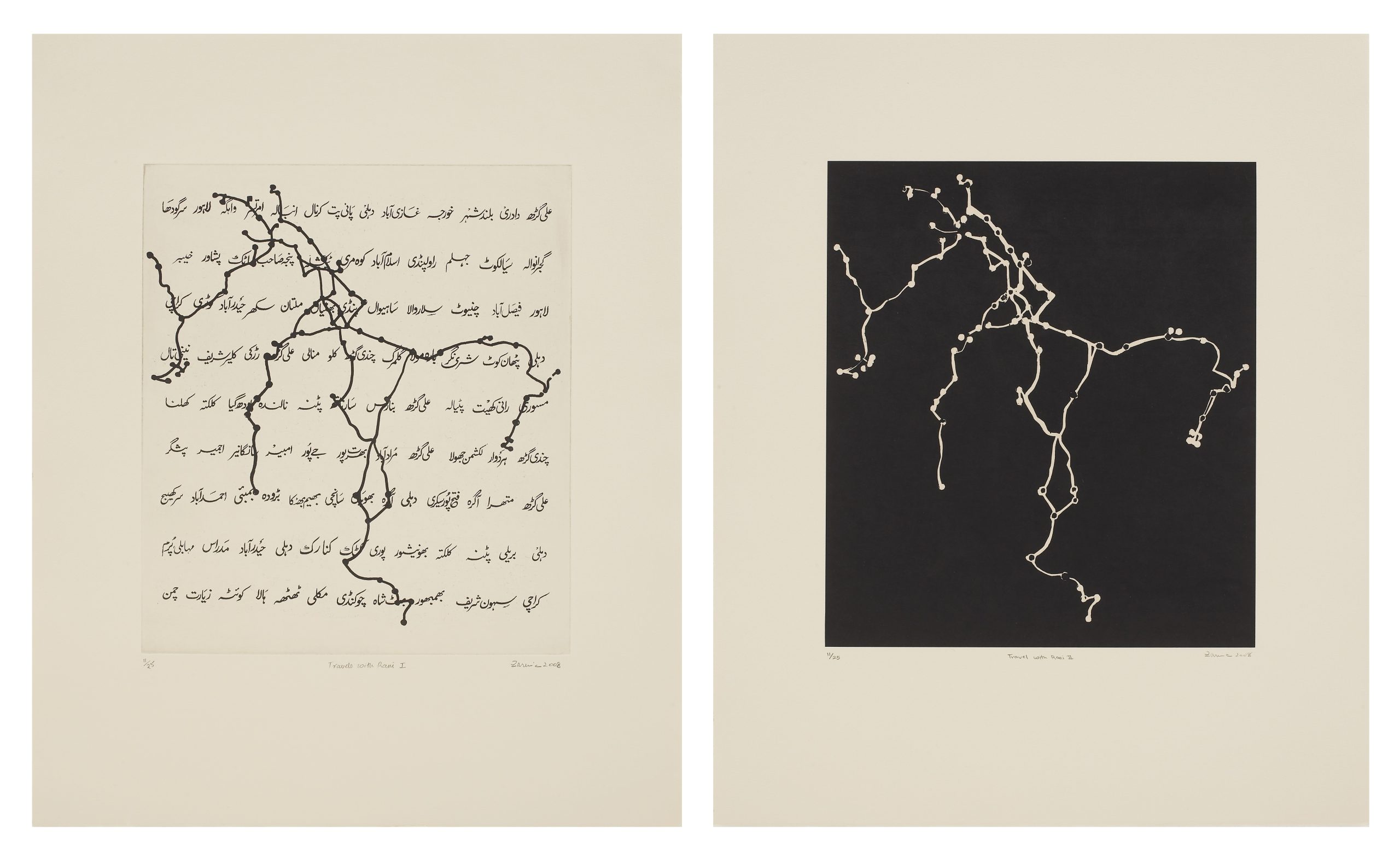
The diptych, Travels with Rani (2008), traces the places in the South Asian subcontinent visited by Zarina and Rani, both as an abstract linear map, but also as a list of cities (Aligarh, Delhi, Karachi…) in Urdu script that reads like stations on a train route that, like language, ignores political boundaries. It might perhaps have been on one of these shared journeys that the sisters first hatched the idea of the Urdu Proverbs prints and book. Travels with Rani make both the abstracted visual world-building of Home is a Foreign Place, and the linguistic one of Urdu Proverbs, concrete. The three works act as an archipelago of shared history and memory.
III.
‘Do not scorn a humble sherd… for even a single sherd provides refuge for an epoch.’ –Mustansar Hussain Tarar8
Let us step into Kazim’s ‘Urdu world’ through the humble sherd.9 In Tteela (2025), a four-panel work on paper, we see an imaginary, almost other-worldly landscape rendered at a scale one could walk into. Kazim’s ancestral village sits near land which previously hosted the Bronze Age Harappan civilisation (3300–1300 BCE) and where terracotta sherds from past civilisations become visible at the surface, particularly after the monsoon. These sherds often bear discernible fingerprints of potters of the past whose names we will never know. The mounds depicted in Tteela, made partly from thousands, perhaps millions, of such sherds, constitute a collective, imagined portrait of a place and the peoples that have shared it over time.

In Firefly II (2008), a white-haired man holds out his right hand under the luminescence of a firefly. The blue-black ground, an allusion to the night sky, is gently illuminated by the insect’s glow. The light of a firefly can symbolise hope, inspiration or an awakening and has featured in lyric Urdu poetry for centuries. Like most of Kazim’s figures, the man seems oblivious of time.
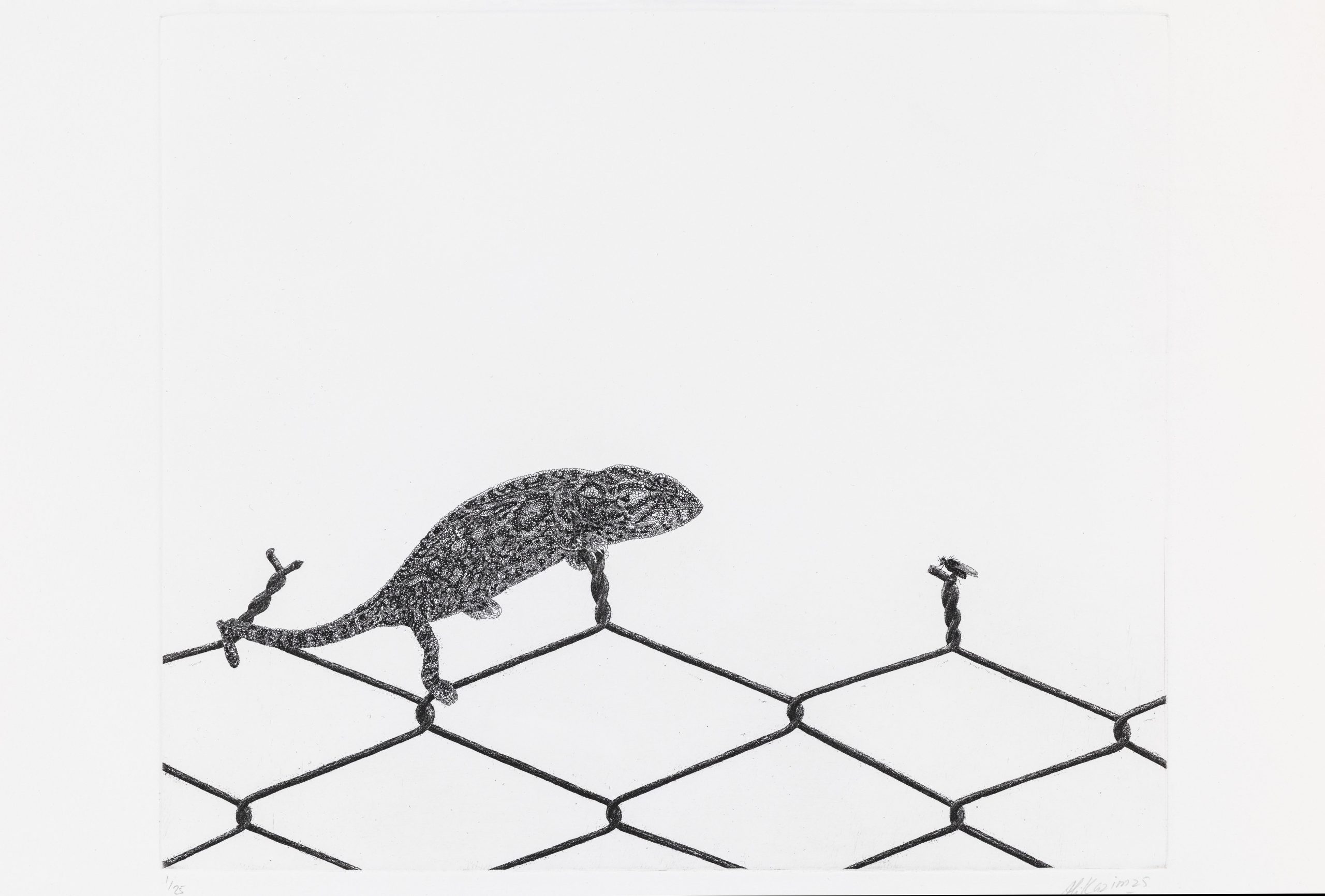
Girgit (Chameleon) (2025) is one of a new portfolio of 19 etchings and aquatints (Alphabets, 2025) produced as part of Ali Kazim: Alphabet Book | Urdu Qaida and first shown in this exhibition.10 In this particular print, most of the surface of the paper is left empty. The bottom half is taken up by a portion of a wire fence. Perched on top on the left is a chameleon with its eye almost closed. Its body, especially its magical eye, is a wonder of tonal variation and distinctive pigmentation. It absorbs the viewer’s attention. Completely. Stay looking for a while, and one notices the fly that is the focus of the chameleon’s gaze. This is a ‘high noon’ moment. We can almost feel the projectile reptilian tongue about to be released.
These three works are a study in stillness. They depict land, and those who share it – past and present, human and more-than-human. This stillness also foregrounds place over time. It is difficult to place even the epoch Kazim’s subjects inhabit, but their location in South Asia is never in question. His paintings, drawings, sculptures, prints and videos trace the role of beliefs, rituals and play in how we live, present ourselves to others and tell stories – to those around us, but also to ourselves. They exhibit a shared simplicity that is not simply achieved. These works have been carefully crafted, like poems or pots; their stillness a reflection of Kazim deploying attention, as both medium and method. This troika of traits – simplicity, stillness and attention – Kazim shares with Zarina. These shared features, a love for working with paper in all its forms, and an unashamed evocation of place, undergirds the conversation between these two artists, despite their starkly different visual vocabularies.
Kazim’s world is anchored in Lahore, where he lives and works; in Pattoki, his ancestral home; and in the literary and mythical tributaries that feed his imagination, and mirror the free-ranging South Asian itineraries of Travels with Rani. His protagonists often have Dravidian features (King Priest, 2005), profess multiple faiths (Untitled (Children of Faith series), 2024– 25) and tell well-travelled stories. Hudhud (Conference of the Birds) (2023), for example, is the legendary hoopoe bird from Sufi poet Farid-ud-Din Attar’s seminal 12th century work, Conference of the Birds, which leads the birds of the world to self-discovery and enlightenment by overcoming human frailties. In the playful self-portrait, Untitled (Mara’s Army II) (2025), Kazim presents himself as one of the demonic warriors that symbolise the temptations, distractions and obstacles sent to disrupt the future Buddha from reaching enlightenment. These two works tell substantially the same story, told centuries apart, that emanate from different traditions – Buddhism and Sufi Islam – that have both enriched the cultural fabric of South Asia.

His techniques are equally varied; drawing from multiple sources, including East Asian wash techniques, South Asian miniature painting and European etching, as he crosses the disciplinary boundaries of ‘drawing’, ‘painting’, ‘printmaking’ and ‘sculpture’ that attempt to contain creative expression in fixed silos. Kazim’s seemingly free-ranging facility with materials and processes may be lightly worn, but has been acquired through years of experimentation and making – drawing with powdered pigments (effectively the dust of organic minerals); painting with layers upon layers of thin washes to create an uncanny depth of texture; creating marks through the application of pressure; and his remarkable sculptural installations fashioned from the detritus of hair salons arranged as rolled ‘sheets’, held together by hair spray, and suspended with invisible thread.
IV.
As expanded on in the forthcoming publication, Ali Kazim: Alphabet Book | Urdu Qaida, ‘language is the technology with which we humans make sense of the world we inhabit, and both communicate and creatively express ourselves’.11
Every language allows us to know the world differently, and Urdu itself has been fed by numerous linguistic rivers – Hindi, Arabic, Persian, Turkish and Punjabi among them. It is these polyglot histories, references and cultures that both artists engage with. Kazim reveals them through wrinkled faces, the gleam of light in people’s eyes, the depth in the folds of their clothes and the fingerprints in mounds of sherds. Zarina literally carves out abstractions of her Urdu worlds into wood. Her choice of print-making as her primary medium, and her decision to publish Urdu kay aik so aik mahavray (101 Urdu Proverbs), reveal a commitment to the circulation of these stories and their visual manifestations.
As viewers of this exhibition, and as readers of their two books, we are invited to lose ourselves in these two artists’ richly entangled Urdu worlds.
Notes
1. Zarina (Hashmi) preferred to use her given name.
2. Hammad Nasar, ‘Finding Her Own Way Home’ in Printmaking Today, Vol. 29, Autumn 2020, Issue 115 (London: Cello Press Ltd, 2020), 24-28.
3. Zarina Hashmi (with Sarah Burney), Directions to My House (New York: Asian/Pacific/American Institute at New York University, 2018), 88.
4. Ibid., 71.
5. Nasar, ‘Finding Her Own Way Home’, 26.
6. Sandhini Poddar, ‘The Garden of Dark Roses: Zarina in conversation with Sandhini Poddar’ in Zarina: Paper Like Skin ed. Allegra Pesenti (Los Angeles: Hammer Museum and DelMonico Books, an imprint of Prestel, 2012), 163.
7. Nasar, ‘Finding Her Own Way Home’, 25.
8. Mustansar Hussain Tarar, ‘For Ali Kazim’ (unpublished) translated by Hammad Nasar.
9. This consideration of Kazim’s work draws extensively on my text, ‘Still/Looking: Ali Kazim’s Language Worlds’ in Ali Kazim: Alphabet Book | Urdu Qaida by Ali Kazim and Hammad Nasar (London: Ochre Books, 2026), vii–xii.
10. Alphabets (2025) is a suite of 19 etchings and aquatints printed by Simon Lawson and published by Cristea Roberts, London in an edition of 25 plus 5 artist’s proofs and 1 printer’s proof.
11. Nasar, ‘Still/Looking: Ali Kazim’s Language Worlds’, xi.

