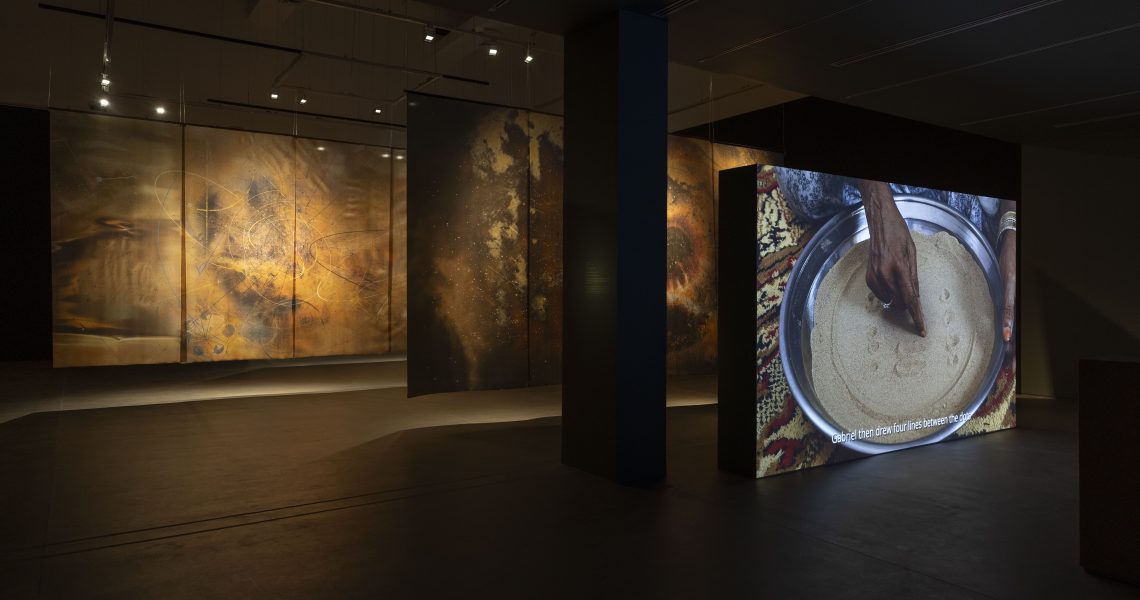
Installation view of The sky held it, the earth remembered at Ishara Art Foundation, Dubai, 2026. Photography by Ismail Noor/Seeing Things
Sasha Altaf: What I find particularly compelling about each of your practices is how you approach the environment as something active, unstable, and relational – something we are all engaged within. This resonates with Édouard Glissant’s idea of relation – not a fixed connection, but something constantly unfolding between beings, histories, and worlds.
In thinking through this, I’ve been returning to Gregory Bateson’s idea of an ecology of mind – the notion that perception, environment, and knowledge are not separate, but form a system of feedback. And also to material semiotics, which asks us to consider how meaning is produced across human and non-human actors: imaging systems, landscapes, and atmospheres.
Across your works, whether in Latent Fields, Lines That World a River, or Dhaka 1217, there is a strong sense that what we perceive is never immediate or neutral.
Rohini, I’m struck by how in Latent Fields, the act of seeing is mediated through telescopes, imaging systems, and data. Shahana, in your work, that mediation feels very different. It’s embedded in lived practices, in drawing, in oral histories. And Sarker, in your photographs, it almost feels like perception emerges through duration and staying with a place over time.
Through this idea of an ‘ecology of mind,’ do you see yourselves as observers of these environments, or as embedded within them? And might perception itself be understood as relational, where the act of seeing is inseparable from what is seen?
Shahana Rajani: I am interested in seeing and artmaking not as individual acts but collective gestures, where to see and represent the world can mean something very different from our secularised, extractive knowledge systems. In my earlier practice, I was invested in tracing the role of visuality and mapping in shaping and erasing landscapes – how seeing and representing are never neutral acts but violent mechanisms for dispossession, and how I as a moving-image artist was entangled in the inescapable legacies of these violent visual regimes. It is here that I began searching for alternative lineages of representation and relation.
Over the last few years, activists and artists brought to my attention local drawing and painting practices through which coastal communities remain connected with their disappearing homelands. It made me understand the expansive capacity of representational acts to keep alive worlds amidst annihilation, to become offerings and prayers for protection and remembrance, and to enable relation and intimacy.
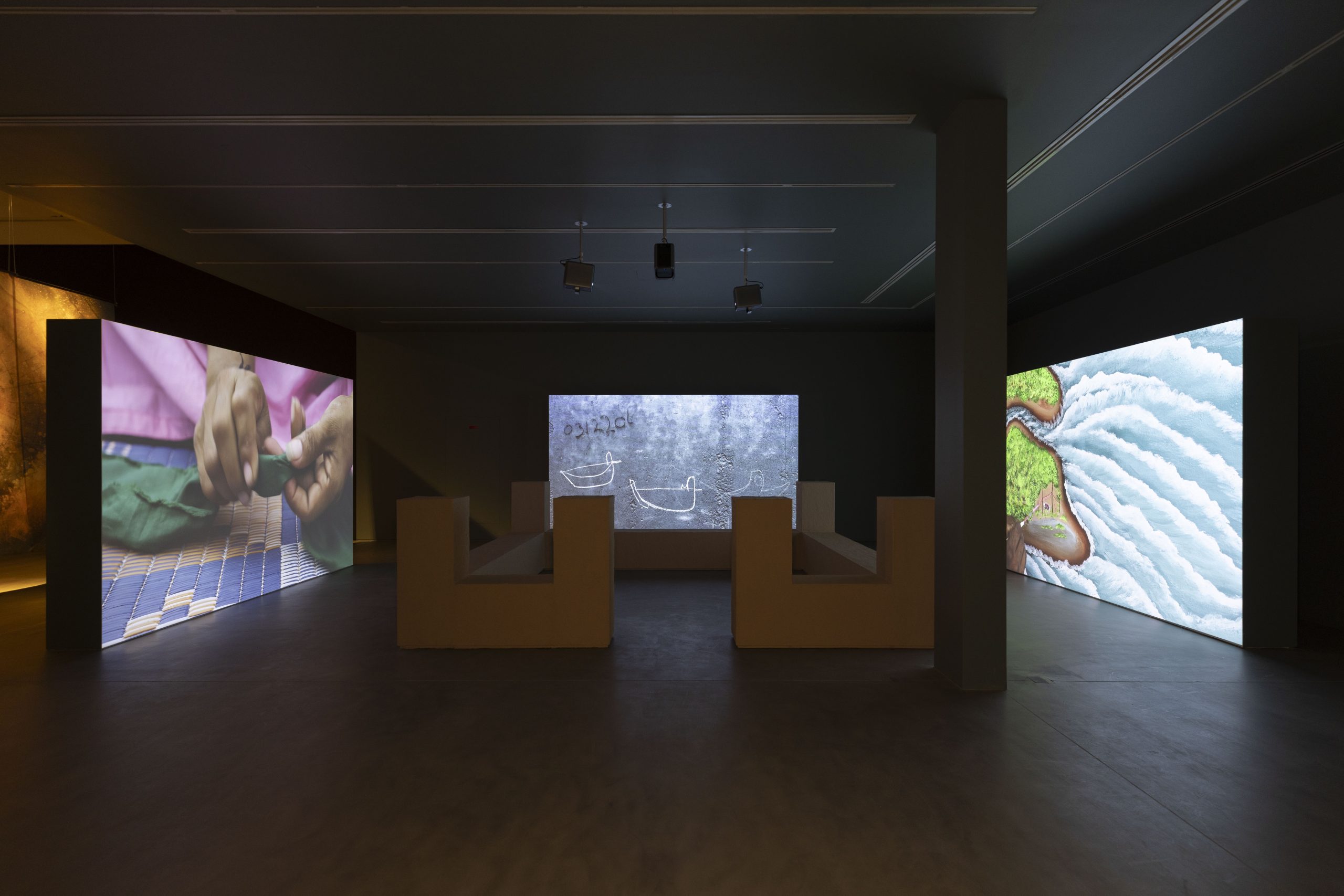
In Lines That World a River, instead of setting out to film the Indus delta myself, I focus on how communities choose to represent their own sacred geographies; what and how to make visible, and what to render invisible. It is not a gluttonous gaze that wishes to see through and represent everything, but one that is attuned and respectful to the sensitive nature of these spaces.
Rohini Devasher: Observation is never unmediated. I am interested in the methods and forms that mediation takes. The observer, the act of observation, also brings in the field of view. When understood within the frame of sight, the field of view is the extent of the observable world seen at any given moment. In quantum mechanics, fields are mysterious fluid-like substances that sometimes act like particles and sometimes like waves. Depending on the observer, the field is sight, resolution, measurement, and interaction all at once.
Sarker Protick: Duration has always been integral to my practice, not only as a method but more importantly as a building block. Perception itself develops over time. The longer you stay with a place, the more your understanding changes with it.
I am part of Dhaka. I was born here, grew up here, and never lived nor intend to live anywhere else. I’m not observing it from a distance. I’m living in it. It is part of my existence and has shaped my identity.
After photographing Dhaka for more than 15 years, I don’t only observe it but the city has also changed the way I see, and what I see. It has redefined my questions, my observations, and my understanding of what this place is.
SA: Material semiotics suggests that meaning isn’t produced by humans alone, but emerges through networks between instruments, bodies, landscapes, and histories.
Rohini, your work makes this very explicit – the telescope, the sensor, and the data stream all function as active participants. Shahana, in the delta, the landscape itself seems to act, eroding, shifting, and submerging. And Sarker, in Dhaka 1217, the atmosphere – the light, the humidity, the passage of time – begins to register as a presence that shapes the image.
Within an ecology of mind, where human and more-than-human worlds are deeply entangled, how does the more-than-human become an active presence in your work?
At what point does the landscape, or technology, shift from something you represent to something you are in relation with? And when that happens, does authorship begin to open out, becoming something shared across these relations, rather than held by the human alone?
SR: I have been working to attune my senses to more-than-human presences that are often important actors and cohabiters of the landscape. Fisher communities understand the river and the sea as sacred beings whose union gives birth to all life and land. As rivers are disrupted, elders explain the sea is coming forward, in search of its beloved river. Through my travels with fisher activist Nawaz Dablo, I was taught that in the delta, we dwell in a landscape that is alive, aware, expressive. As painter Abdul Sattar explained, wherever you turn in the ocean you find the face of God. We pray to the divine, bera par kar. We learn to listen to the land, attuning to the breath and the body; remembering that our senses and ways of knowing have formed in reciprocity with the textures, sounds and shapes of an animate aquatic world. The river, the sea, the saints, the fish all emerge as kin, companion and witness. The landscape begins to speak back.
Lines That World a River centres these provocations and socialities, exploring how murals and paintings become a medium and portal to access and experience the delta’s sacred, spirit, and ecological worlds. In the creeks and islands of the region, the shrines of saints known to protect the delta continue to exist. As people are forced to leave to their relocated towns and cities, they ask artists to make paintings of their shrines.
The Sindhi word for indigenous, maqami, derives from the word maqam, meaning gravesite. To belong to the land, is to be connected to the dead. In a world rendered unstable, these shrines endure as orientation devices. Saints and spirits are ever-present, imparting miracles, dreams, visions and signs. They ground, sustain and guide. They help devotees navigate a world turned ulta pulta, upside down. In place of the material grave, the image now becomes intermediary for the saint. Art-making participates in a spiritual undertaking and invocation to remember.
RD: The observer is always part of what they seek to observe. Oxana Timofeeva in her book Solar Politics talks about how without being identical to the Sun, a human eye is very similar to it. She describes how we can look at this object and see it because in certain aspects we are akin to it. Our eyes have evolved to see because of the light of the Sun, but it is this same light that prevents us from ‘seeing’ the star nearest us. The only time we can safely look at the Sun is during the brief seconds of totality during a total solar eclipse. This led to one of my favourite parts in One Hundred Thousand Suns, my recent 4-channel video installation, which considers the Sun as both knowable and unknowable. We see a human eye that is gradually eclipsed by its own pupil.
We construct our environment and it in turn feeds back into us. Every observation is also the creation of a world. These entanglements fascinate me and deepen the exploration of new cosmologies between the human and more-than-human.
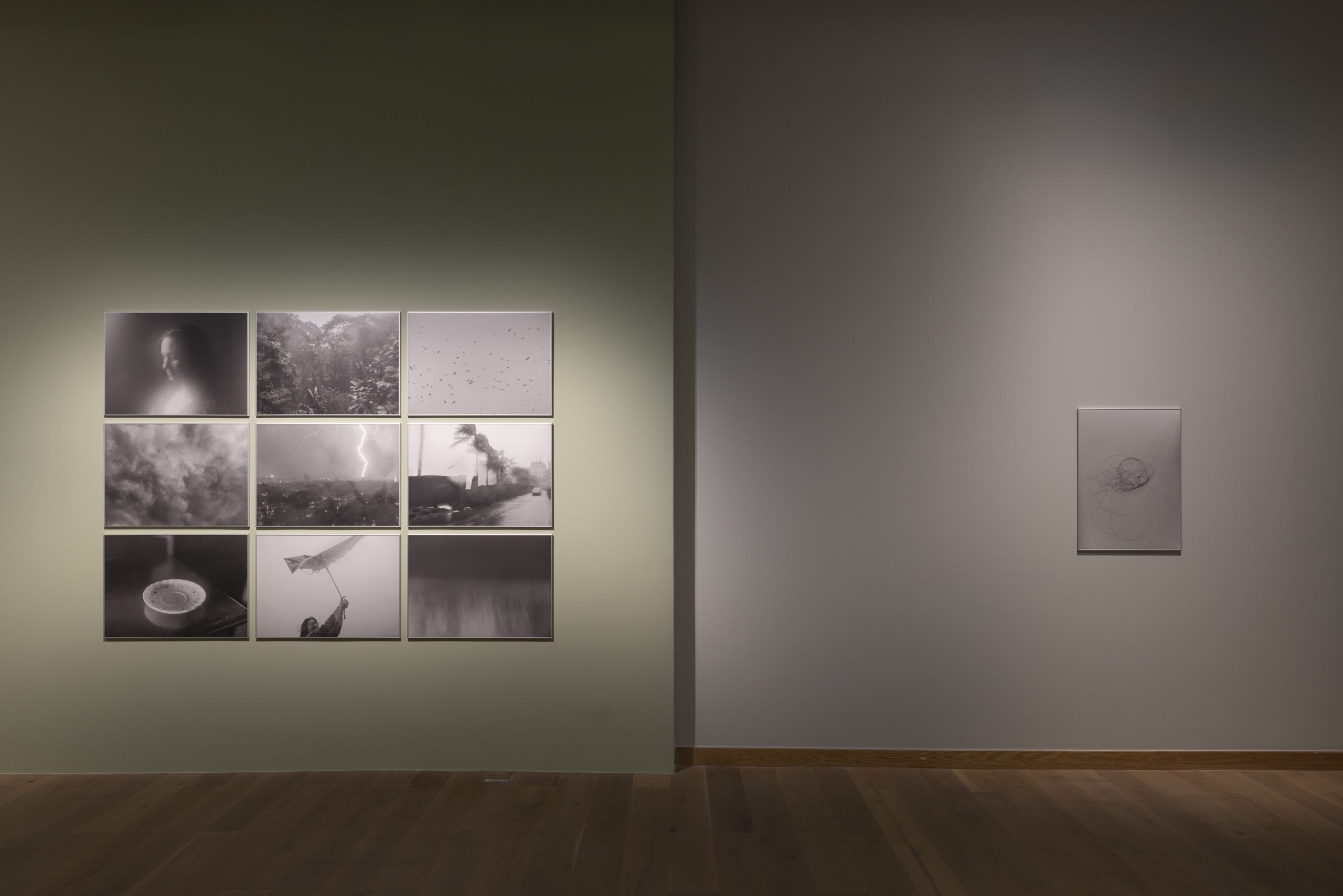
SP: Light and time are the two fundamental elements of photography. For me, they are never secondary to the subject. It’s a bit like music or songwriting. No matter what a song is about, rhythm and melody are the primary conceptual frameworks. In photography, light and time operate in a similar way. I can’t separate them from the subject that I am speaking of.
In visual mediums, weather can add a powerful voice. The humidity of the monsoon, the winter haze, or the heat of bright summer days – each can transform the atmosphere of a place in distinct ways. Atmosphere can create a psychological space within a physical one, another dimension on top of the immediate one. It allows a photograph to go beyond a record of a scene, becoming a place that someone can inhabit emotionally. In Dhaka 1217, the weather becomes a protagonist.
The light changes, buildings disappear in the backdrop, seasons return differently every year. The photograph is never made by me alone, but in collaboration with the city and the weather, the hour of the day and all that lives in a given moment within the frame.
Authorship is vital. My role is to shape those encounters into a coherent world. I’ve always admired writers and filmmakers who take world-building seriously. That’s what I’m trying to do with Dhaka 1217 – to create a world that viewers can enter.
SA: One of the things that connects all three of your practices is how they complicate the idea of the Anthropocene. Often, the Anthropocene is framed as this singular, global condition, but your works insist on very specific, situated experiences.
Shahana, in Lines That World a River, the delta is not just a site of climate crisis, but also of memory, ritual, and loss. Sarker, your work traces a kind of slow transformation in Dhaka – something incremental, almost imperceptible. And Rohini, your work expands this out to scales that are almost impossible to comprehend, from the subatomic to the cosmic.
How do you each negotiate scale? And how does working across or within these different scales reshape how you think about human agency in the context of environmental crisis? I’m thinking here of how writers like Amitav Ghosh have pointed to the difficulty of narrating climate at the planetary scale – how it often exceeds our habitual forms of perception and storytelling. Do your practices offer alternative ways of sensing or holding scale?
SR: The scale of devastation and displacement in the Indus delta is vast and immense. The culture economy is built on a fetishisation of such violence, but I was not interested in totalizing narratives of ruin and catastrophe. The mural painting and talismanic practices are intimate ways in which fishing communities are negotiating the ongoing climate collapse. They are sites of abundance amidst annihilation. The film refuses to show ruined, desolate landscapes, but centres these vibrant paintings and practices.
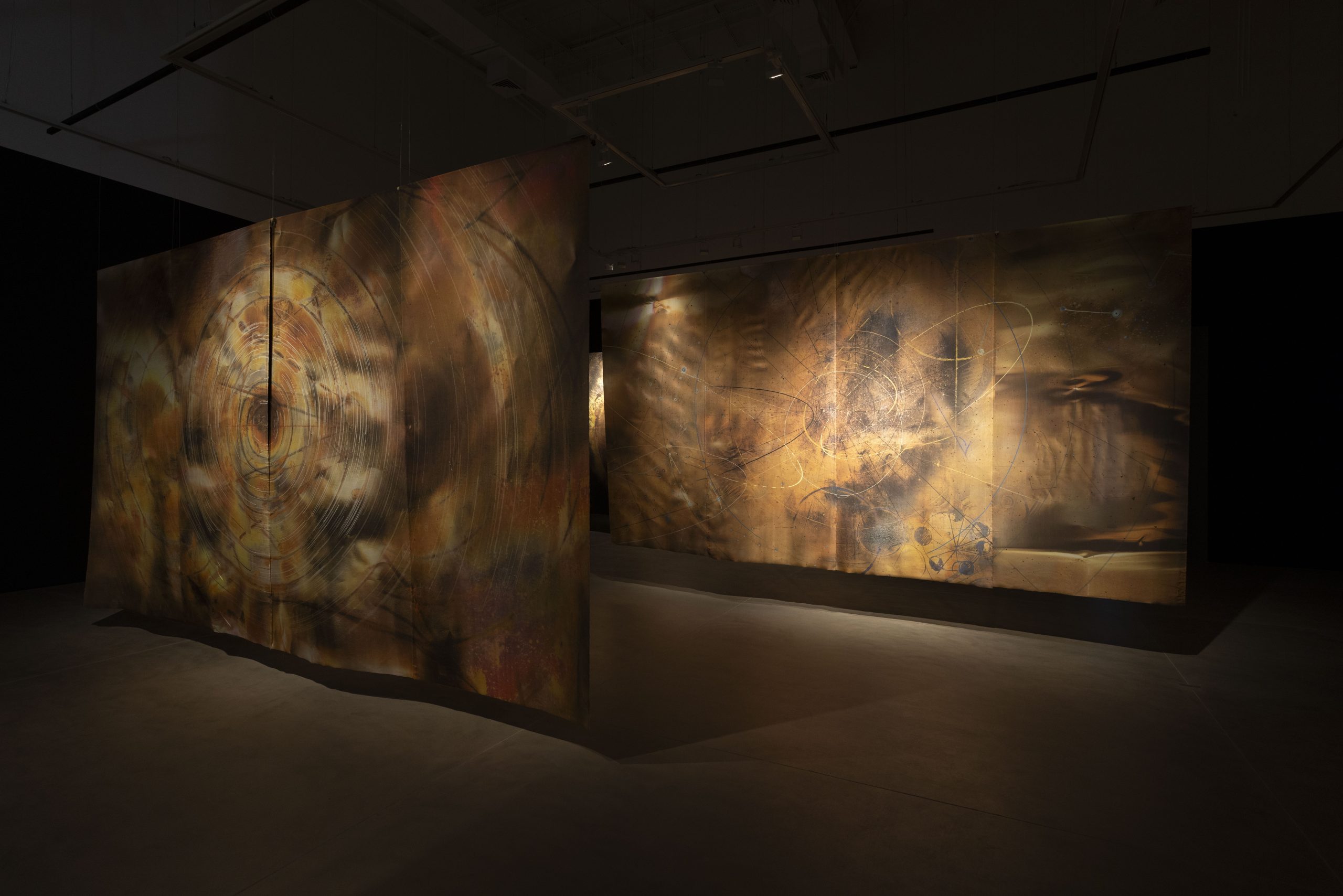
RD: Scale has always been an important part of my practice, whether in the form of large site-specific wall drawings or tapestries on silk as in the case of Latent Fields. I have done large, curved wall drawings, where when you stand in front of the work, there is a kind of almost sonic dissonance created, a kind of buzzing in the mind that comes just from the image interfering with your peripheral vision. In Latent Fields, it was important to create a sense of scale, but also of presence – the Sun’s presence; as an entity, as active, not passive, as something that might be looking back at you. The different fields ask you to move through space and to pay attention in a different way. The idea was to plot a crossing through the body of a star: from the sub-atomic to the atmospheric, from the centre of a sun to the outer edges of the galaxy.
SP: Working over a long duration has taught me that environmental change is often quiet. Oftentimes it happens below the level of everyday attention.
That slow approach is something I deliberately pursue, especially today when everything feels increasingly instantaneous and reactionary. We form opinions quickly and move on just as quickly. But a city has lived over decades, not just in moments.
I don’t think my work could exist if I responded only to immediate events. I need time to understand what I’m looking at.
SA: I am also interested in how each of you engages with the limits of visibility – navigating the space between what can be seen, sensed, and imagined.
Rohini, in Latent Fields, there is distortion, latency – things that resist clarity. Shahana, your work deals with submerged histories – things that cannot be fully recovered. Sarker, your images often seem to withhold more than they show.
Rather than trying to make everything visible, are your works in some way insisting on the limits of visibility? And what does it mean, especially in the context of environmental crisis, to work with what cannot be fully seen or known – to allow for partiality, opacity, or even uncertainty as a condition of engagement, rather than something to be resolved?
SR: I have learned so much from talisman makers and mural painters about the process, possibilities and potentials of withholding. Once drawn, the taweez (talisman) is folded many times over into tiny paper squares to be carried or worn on the body. In a world where the human gaze desires to render all transparent, the folded taweez withholds from view. It differentiates devotion from consumption.
Painter Abdul Sattar explains that his murals also veil and withhold. A painting reveals its divine secrets only to those who know how to look beyond the surface.
RD: Sometimes visibility needs to be rethought. When an amateur astronomer is trying to see a very faint object – say a deep sky nebula or a faint galaxy – they use averted vision. In other words, they look off its edge to see it more clearly. Because the rod cells in our peripheral retina are much more sensitive to low light, this technique of observation allows observers to see objects that might otherwise be invisible. The limit of visibility is also at the threshold of hallucination, which I find fascinating.
SP: One of photography’s paradoxes is that it reveals so much, so quickly! The image immediately tells you, “This is what it is.” So where do we go from there? I’ve always been keen to resist that certainty.
I don’t feel strongly that a photograph always has to explain itself, everything in it. There should be space for viewers to bring their own memories, experiences, and questions into the work, and meet halfway. This uncertainty isn’t a lack of information but rather an invitation. It allows the photograph to become a space of intimate viewing.
SA: Shahana, your work is deeply collaborative, and it makes me think of Grant Kester’s idea of dialogical aesthetics, where meaning emerges through conversation and shared processes.
I also see a form of dialogue in both Rohini and Sarker’s work, though perhaps less directly. Rohini, your dialogue might be with scientific systems and histories. Sarker, yours might be with the city itself, over time.
What does dialogue mean within your practices? Is it always human-to-human, or can it also be with landscapes, with technologies, with time?
And if we think with Glissant again, could dialogue be understood more expansively as relation itself – a process of telling, listening, and connecting that unfolds across human and non-human worlds alike?
SR: An important site of dialogue in this work, is between so-called ‘new’ media and ‘traditional’ media. In exploring drawing and painting, through the mediums of video and animation, I wanted to reimagine the ways in which we understand and hierarchise these media. Local drawing and painting practices became my guides for how to think about representation differently; as an act and ethics of relation, connection, love, and devotion with human, natural, and sacred worlds. They reveal themselves as animate, enchanted, and inventive practices that can share a mutual resonance with the dynamism of moving image.
RD: With Latent Fields, I was looking at the dialogue between different kinds of networks and registers of time, history, and material. In the early 20th century, a new frontier in photography was developed through experiments in particle and nuclear physics. Bubble chambers such as Gargamelle at CERN were used to record and investigate fast-charged particles in remarkably high spatial resolution. At the other end of the field of view are the Hubble Deep Field images, constructed from a series of separate exposures taken by the Hubble Space Telescope in 1995 and 2012. The Deep field observations reveal the most distant stellar objects ever observed. The ‘deeper’ the observation, the fainter the objects that become visible on the images. In the work, I have drawn from images in the CERN archives but also played with this idea of immense scales of deep time, and the limits of the observed and the observable.
SP: I think we’re always in conversation with our surroundings, whether we’re conscious of it or not. For an artist, it’s important to develop deep roots in a place. Those roots are nourishing to us.
In Bengali there’s the word shomporko. In English it directly translates as “relationship,” but something deeper is lost in translation. It carries a sense of belonging, familiarity, responsibility, and affection all at once. That’s probably the closest way I can describe my relationship with Dhaka.
The dialogue isn’t only with people. It’s also with the crows, the stray cats, the rooftop gardens, the small parks, the lakes, that old house that is still standing in the corner of the neighbourhood. These conversations unfold over years, with time itself.
SA: As we’ve been speaking, one thing that keeps emerging is that none of you are simply representing environmental crisis.
Instead, you are each proposing distinct ways of sensing it, of relating to it, of being within it – through practices that unfold across complex networks of human and non-human actors, of memory, technology, and environment.
This suggests that relation itself – if understood as a continuous process of telling, listening, and connecting between self and surroundings – is not just a condition, but a method.
And perhaps also, as Amitav Ghosh has argued in a different way, art and narrative have a crucial role in reconfiguring how we perceive and inhabit the climate crisis, especially where conventional frameworks fall short.
So as a final question: Within these relational systems, how do you conceptualise your role as artists? Do you see yourselves as observers or as mediators who translate and rearticulate the conditions through which these dynamics become perceptible? Or perhaps as practitioners whose work participates in shaping these relations themselves, where aesthetics is inseparable from the ways in which the world is understood and lived?
And in that sense, are you not only engaging these systems, but subtly transforming the conditions through which they can be sensed, narrated, and imagined?
SR: I place myself in relation with the city, its surroundings, and ongoing struggles. I see myself participating in these spaces, being transformed by them. Collaboration is very much at the heart of my practice. My methods emerge from my pedagogical project of Karachi LaJamia with friend and artist Zahra Malkani. Since 2015, we have been organising public courses and research projects in collaboration with indigenous activists and community organisations fighting to protect the city’s land and rivers. Research becomes the collective work of community building. As we spend time in these spaces, the camera is never at the centre of why we are there. It’s about learning from those around us, the custodians of the land and the river, and questioning the institutionalised forms of knowledge and representational practices that we grow up learning and valuing. We try to situate art practice and pedagogy in the larger urban context by creating collective learning environments. In so many ways, the community murals do precisely that pedagogical work. Perhaps that is why I was so drawn to them.
RD: All of the above, observer, participant, mediator, translator and re-thinker.
SP: I see myself as a participant first. A bahsinda (inhabitant). I’m translating my own lived experience in the city, but I also recognise that the work gradually becomes an archive. So I suppose I’m participating, translating, and documenting, all at the same time.
I don’t necessarily think the work needs to change how people see Dhaka. Perhaps it can. In the context of Dhaka 1217, it is enough if the work simply reminds them of something they already knew, but haven’t felt for some time. It’s less about educating, and more like a slight nudge to a sense that was already there.
References
Bateson, Gregory. Steps to an Ecology of Mind: Collected Essays in Anthropology, Psychiatry, Evolution, and Epistemology. New York, Ballantine Books, 1972.
Ghosh, Amitav. The Great Derangement: Climate Change and the Unthinkable. Chicago, University of Chicago Press, 2016.
Glissant, Édouard. Poetics of Relation. Translated by Betsy Wing. Ann Arbor, University of Michigan Press, 1997.
Glissant, Edouard. Poetic Intention. Translated by Nathalie Stephens. Callicoon, NY, Nightboat Books, 2010.
Law, John. “Actor Network Theory and Material Semiotics” in The New Blackwell Companion to Social Theory, edited by Bryan S. Turner, pg.141–158. Oxford, Blackwell Publishing, 2008.
Kagan, Sacha. Art and Sustainability – Connecting Patterns for a Culture of Complexity. transcript Verlag, Bielefeld, 2011.
Kester, Grant H. Conversation Pieces: Community and Communication in Modern Art. Berkeley, University of California Press, 2013.

